Translation is "solved," long live translation!
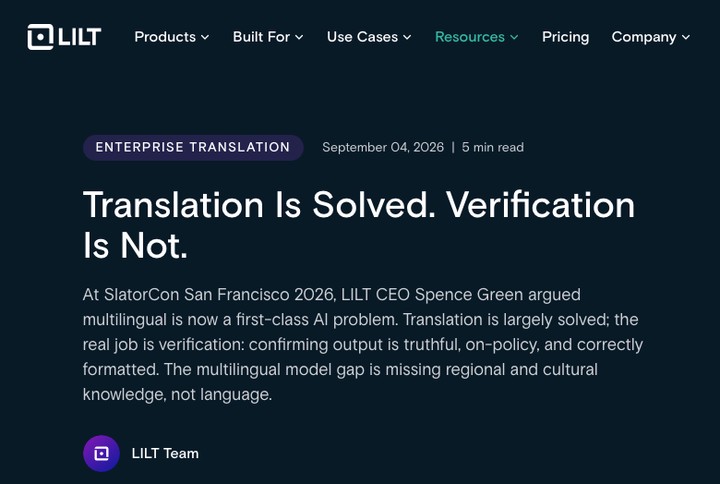 Image: LILT Entry “Translation is solved. Verification is not”
Over the last couple of years, I have regularly heard versions of the claim that “translation is solved” at industry events, most recently at SlatorCon in San Francisco. LILT’s presentation refined the point: “Translation is solved. Verification is not”. I find the phrase useful not because I agree with it exactly, but because it reveals where the industry’s confidence currently sits, and because it creates a bridge between academia and industry: it shows that we often use the same word, “translation”, to mean different things.
In LILT’s account, “translation” is used to mean language replacement: generating a text in one language from a text in another. On top of that, verification means checking that output is truthful and accurate, follows predefined guidelines and is presented in the right format. With current AI tools, the language replacement process can be automated to a large degree (LILT’s own write-up says “largely solved”, though the headline drops the adjective). This is a fair way to describe what clients see and what they buy: they want a text presented in a different language.
In translation studies and translator training, “translation” has always meant that fuller picture. It was never only about swapping languages. It has always included understanding what a text needs to do, who it is for, what the commissioner wants, and what could go wrong if the translated text or product doesn’t work. Professional translators, interpreters and language professionals do this daily, even though the work isn’t described with a different label. Much of what is called “verification” is work that language professionals have always done, under the same name as the transfer.
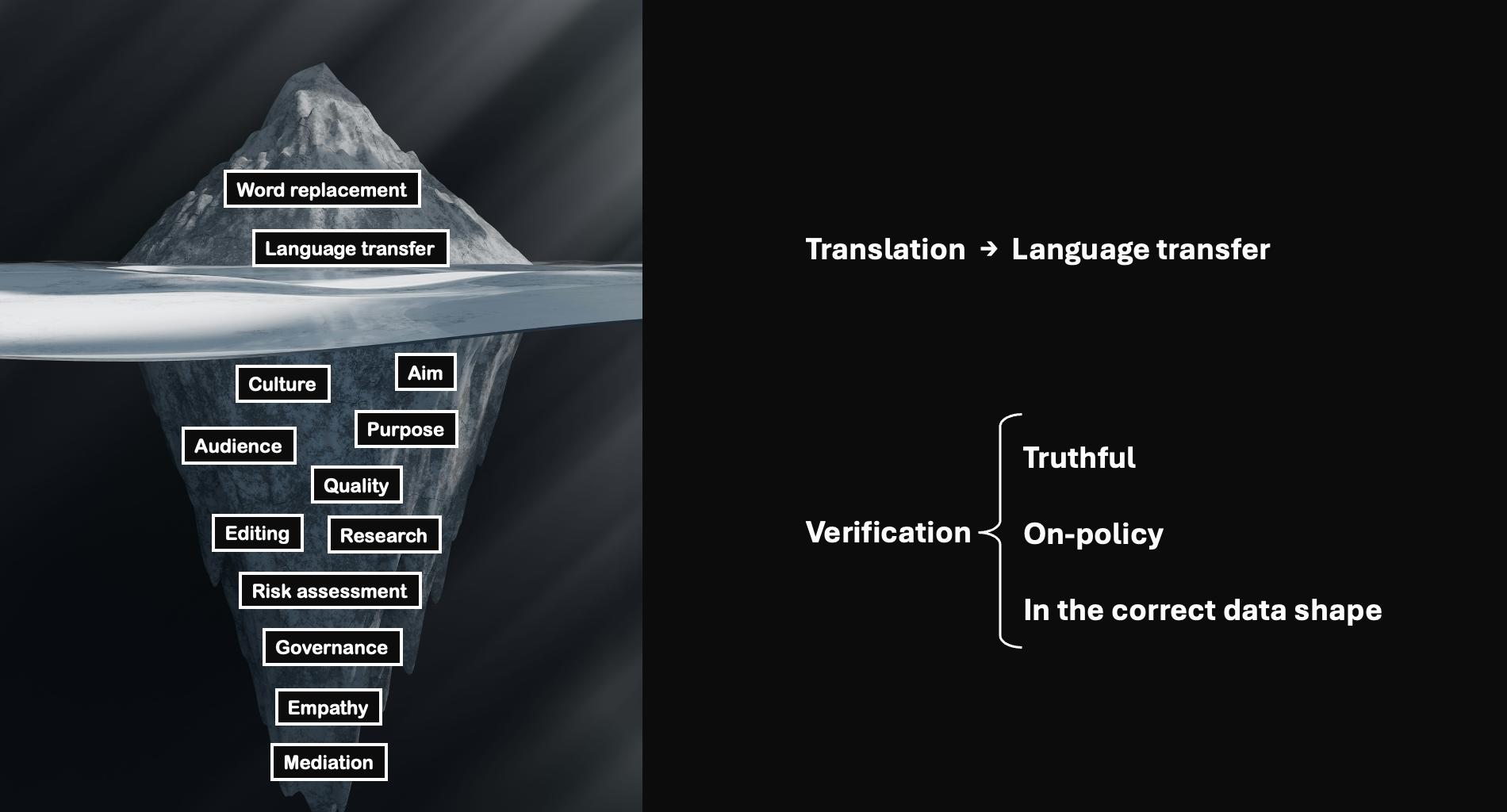
This understanding of translation as a broader service gives us a shared starting point that brings two things into focus: the knowledge this fuller work depends on, and the benefit of communicating through an appreciation of difference. As localisation and multilingual content production expand, there is an opportunity to make both visible in how the industry specifies, buys and evaluates this work.
The knowledge hidden inside translation
The overlap is easy to miss because, until recently, the two parts have always come together through human involvement. Translation as a service has always absorbed this work. Clients ask for a translation, and what they receive includes the queries, the adaptations, the checks on tone and purpose, and the judgment about what the text needs to do. Much of this does not appear in the quote or the contract, because the professionals and providers doing the work understand that the word “translation” covers it. That has never been a problem, because a person doing the translating did both parts at once, without needing to separate them.
Automating the transfer makes the separation visible. This is also why the idea of the “human touch” is invoked so often in the industry. Every professional makes specific decisions depending on the project they have in front of them: the subtitler who replaces a cultural reference, the public-service interpreter who picks up on non-verbal cues, the technical translator who queries an ambiguous instruction before it reaches the user manual. Everyone agrees this mediation work is essential. What has been missing is a shared name and a shared place for it in how translation gets commissioned and trained for. Now that this work is no longer bundled with transfer by default, we need better ways to name, specify and value it.
Translation as attention to difference
Translation is also one of the main places where we meet other languages and cultures, and translators spend much of their training learning to notice where those differences matter and what to do with them. A translator decides whether a culture-specific term stays as it is, gets replaced with an equivalent or gets a short explanation; whether readers should feel the distance from the source or be spared it. None of these choices is neutral, and each one shapes what the audience learns about the other culture.
This is expertise the industry can draw on directly. When the transfer runs on its own, someone still needs to decide, deliberately, what to keep, what to adapt and what to explain, or the output settles on whatever is most familiar by default. That decision is the training our graduates receive, and it is useful for any product moving across languages and markets.
None of this is an argument against automation. Every company that enters a new market or adds an AI tool takes on more decisions about purpose, audience, risk and difference, and more content moving between people who don’t share a language. As more companies expand internationally, translation grows and the infrastructure around it needs to support efficient implementation. The transfer is getting cheaper, but the decisions around it are multiplying, and someone has to make them well to ensure success in new markets.
Translator training programmes are already building for this. Our MA in Translation and Cultures at Warwick approaches this from different angles. Students work with CAT tools, but they also plan projects, define workflows, assess quality and manage risk, evaluating how AI tools are implemented rather than only using them.
They subtitle real material while examining how automation is changing the media localisation industry, and clearly defining their target users. They look at competence frameworks, the role of technology and the ethics of the profession, with the option to engage with language service providers. Our main advantage is the combination: graduates who can work with AI tools and ask what a text is for, who it reaches and what could go wrong, ready to help companies use AI well, not only check what it produces.
For that to work, graduates and trainers need access. We need to understand what is happening in the industry, and the industry needs to know what we are doing in our classrooms. More importantly, this exchange needs to happen further upstream: in the workflows where language technology is selected, implemented and evaluated; with the people who make those decisions; and on real projects. That is where academic knowledge about purpose, audience, risk and difference can do more than describe change after the fact. It can help shape how multilingual communication is designed.
This is where I would like to see academia and industry meet: building on the fact that we already agree on much of what the job requires, even if we name it differently.
That is why this knowledge and expertise are needed more than ever. Translation may be “solved,” but only if we define it narrowly. Long live translation.
David Orrego-Carmona
Reader (Associate Professor) in Translation Studies
My research interests include translation technologies, AI, subtitling, non-professional translation and training.